


Ingredients
- 2 lbs silverside, topside or top rump beef, in one piece
- 3 tablespoons brown malt vinegar or apple cider vinegar
- 2 tablespoons coarse salt (rock or sea salt, not iodised)
- 1 teaspoon coarsely ground black pepper
- 1 tablespoon whole coriander seeds
- 1 tablespoon brown sugar (optional)
Instructions
- Use a lean, evenly shaped cut: silverside and topside are the classics, and top rump works well. Trim off the silver skin and any thick gristle. Leave a thin layer of fat if you like it; biltong makers argue about the fat, and it is a matter of taste. Keep the meat cold until you cut it.
- Cut the meat with the grain into strips 1" thick, about 2" wide and as long as the piece allows. Cutting with the grain keeps each strip in one piece while it hangs; you slice across the grain only when it is dry.
- Toast the coriander seeds in a dry pan over a medium heat for 2 to 3 minutes, shaking the pan, until they smell fragrant and turn a shade darker. Crush them coarsely in a mortar and pestle, or with a few quick pulses in a spice grinder: you want cracked seeds, not a powder. Mix them with the salt, pepper and brown sugar.
- Lay the strips in a glass or ceramic dish, not a metal one, which the vinegar reacts with. Sprinkle the vinegar over them and turn the strips until every side is wet, then press the spice mix onto every surface.
- Cover and refrigerate for 12 to 24 hours, turning the strips halfway through. Twelve hours gives a milder biltong; a full day gives the classic salty bite.
- Lift the strips out of the dish and let the liquid run off. Pat them lightly with paper towel to take off the surface moisture, keeping as much of the spice crust as you can.
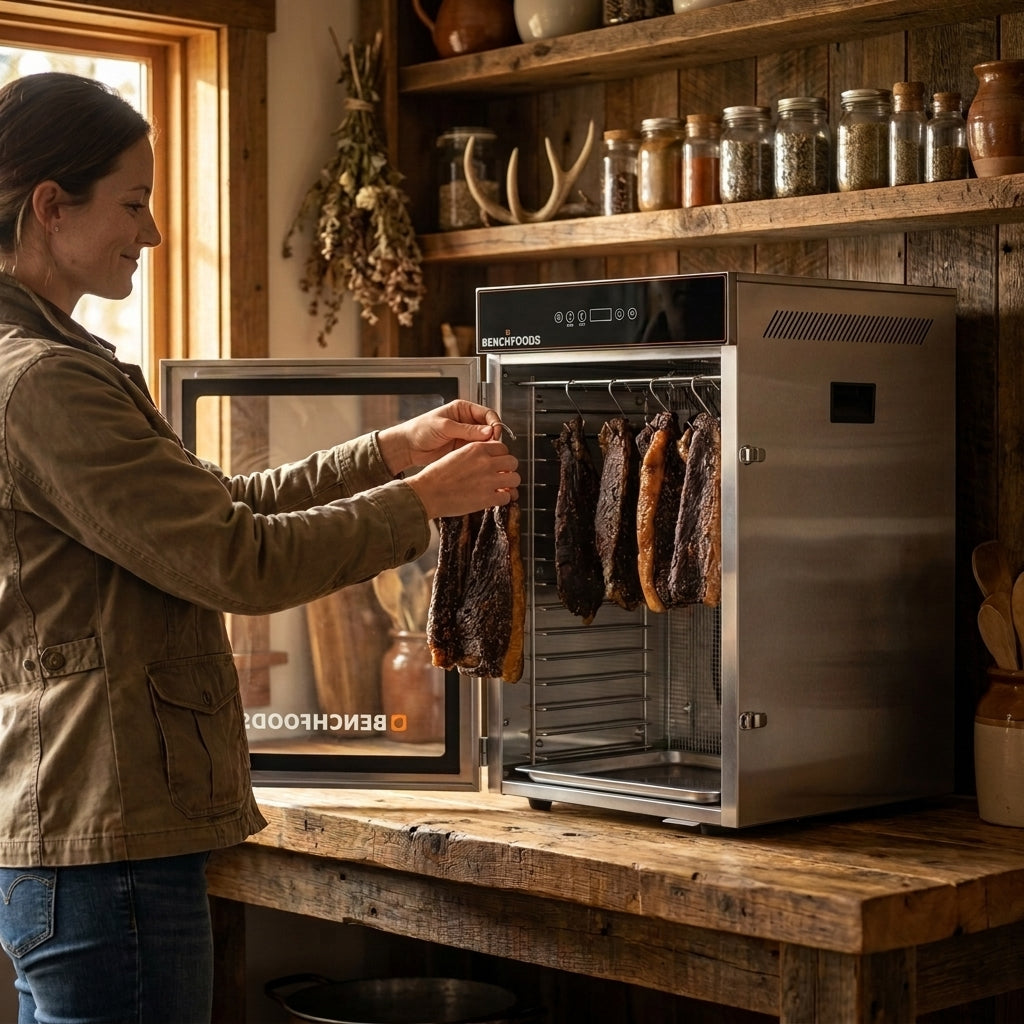
- Push a butcher hook through the thick end of each strip, about 1" in, and hang the strips on the racks so that no strip touches another or the walls; air has to reach every side. Put the drip tray in the bottom to catch what drips in the first few hours.
- Dry at 75 °F for 72 hours. Keep the heat low: biltong is air-dried, not cooked, and more heat hardens the outside before the inside has dried.
- At 72 hours you have wet biltong: dark and firm outside, deep red and moist in the middle. For medium biltong give it another day, and for dry another two; the thicker and fattier the strips, the longer they take. Pinch the thickest part of a strip: when there is no give left for your taste, it is done. Slice one open to check the middle.
- Slice thinly across the grain with a sharp knife or a biltong cutter, and enjoy.
- Keep biltong in a paper bag at room temperature and eat it within a few days, or keep it in an airtight container in the fridge for up to 2 weeks; it freezes well for longer. Never seal wet biltong in plastic at room temperature: it sweats and grows mould.
Nutrition
| Per 1 oz (28 g) | Per 100 g | |
|---|---|---|
| Energy | 105 kcal | 369 kcal |
| Protein | 15.2 g | 53.5 g |
| Fat | 3.8 g | 13.4 g |
| saturated | 1.4 g | 4.9 g |
| Carbohydrate | 1.4 g | 4.8 g |
| sugars | 1.2 g | 4.1 g |
| Fibre | 0.1 g | 0.4 g |
| Sodium | 963 mg | 3396 mg |
Estimated from the ingredients, for the finished dried product. Actual values vary with the produce you use and how far you dry it.


Leave a comment
Cooked this? Have a question? Comments are read by our team before they appear, and we answer questions here.