Dehydrator vs Freeze Dryer: What's the Difference?
A dehydrator dries food with warm moving air. A freeze dryer freezes it and removes the ice under a vacuum. Here is how they compare on cost, storage life, nutrition and texture, and which one to buy.
On this page 10
- Is a dehydrator the same as a freeze dryer?
- What's the difference between a dehydrator and a freeze dryer?
- Is freeze dried food healthier than dehydrated?
- How long does freeze dried and dehydrated food last?
- Freeze dried vs dehydrated: fruit, vegetables, meat and herbs
- How much does a freeze dryer cost compared with a dehydrator?
- What are the downsides of freeze drying and dehydrating?
- Which is better: a freeze dryer or a dehydrator?
- More questions about freeze drying and dehydrating
- Sources
Last updated November 2026. Sources are listed at the bottom of the page.
Short answer: no, a dehydrator is not the same as a freeze dryer. Both remove water so food keeps without refrigeration, but a dehydrator does it with warm, moving air, while a freeze dryer freezes the food and then pulls the ice out as vapour under a vacuum [1]. That one difference explains almost everything else: the texture, the storage life, the nutrition, the time each batch takes and the price.
In practice the two machines do different jobs. Freeze drying is mostly about long-term food preservation: it suits food you want to keep for years, but the machines cost thousands and a batch takes 20 to 40 hours [1][2]. Dehydrating is more about eating the food. It stretches fresh produce further and cuts food waste, and because you make it yourself, you know exactly what is in your snacks and meals. A dehydrator costs a fraction of the price, finishes most batches in 4 to 16 hours [1], and is the machine behind jerky, biltong, fruit leather and dried herbs. This guide compares the two on the things people ask about most, then helps you choose.
Is a dehydrator the same as a freeze dryer?
No. A dehydrator and a freeze dryer are different machines, and freeze drying is a different process from dehydrating.
- Dehydrating uses only heat and airflow. Warm air moves over the food and the water evaporates [1].
- Freeze drying first freezes the food to around −40 °C (−40 °F), then uses a powerful vacuum to turn the ice straight into vapour, then finishes with gentle heat [1][2].
Both leave food with far less water in it, which is what slows spoilage. They get there by very different routes, and the result is two very different products.

What's the difference between a dehydrator and a freeze dryer?
| Dehydrator | Freeze dryer | |
|---|---|---|
| What it is for | Eating what you make, stretching fresh food further, cutting waste and knowing what is in your food | Long-term food preservation |
| How it dries | Warm, moving air evaporates the water | Freezes the food, then a vacuum turns the ice into vapour |
| Time for a batch | 4 to 16 hours for most foods [1] | 20 to 40 hours [1] |
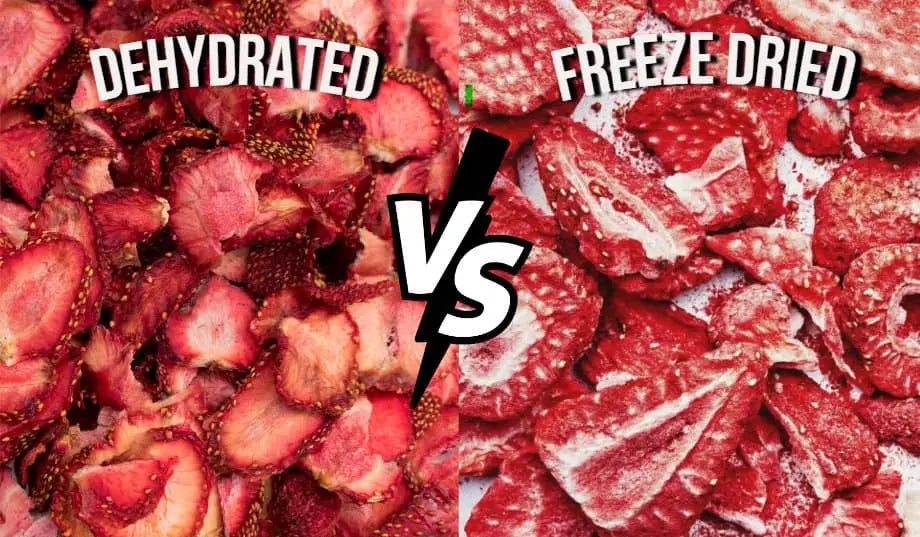
| Texture | Chewy, leathery or crisp, depending on how long it dries. Food shrinks | Light and crunchy. Keeps its shape and colour, and does not shrink [1] |
| Heat-sensitive vitamins | Some loss, which depends on the food and the drying temperature [1][4] | Often higher vitamin C retention [1][4] |
| Storage life | 4 months to a year in ordinary home storage [3]. Packed airtight and kept cool, properly dried food can keep 5 to 10 years [5] | Up to 25 years in the best case, packed airtight with oxygen absorbers [1] |
| Foods it suits | Fruit, vegetables, herbs, jerky and biltong, pet treats, fruit leather | Fruit, vegetables, cooked meals, dairy and more. Not high-fat foods [1][2] |
| Price to buy | Much lower. See each BenchFoods model's product page | About US$2,500 to US$6,000 for most home models [1] |
| Upkeep | Clean the trays and wipe the unit down | Vacuum pump oil changes, or an oil-free pump at extra cost [1] |
| Space and noise | Sits on a bench or the floor | Needs ventilation. Some models are loud, and large ones may need a dedicated 20-amp circuit [1][2] |
Is freeze dried food healthier than dehydrated?
Not as clearly as people assume. Freeze-dried food keeps its size and colour, so it looks as if it must have kept more nutrients, but looks are not the whole story. Freeze drying starts by freezing food to around −40 °C (−40 °F) [1][2], and the ice crystals that form can damage plant tissue and its cell walls [6]. A review of freeze-drying plant-based foods lists oxygen, high temperature and cell damage as the usual enemies of nutrient and bioactive compound retention [6]. So heat on one side and cell damage on the other can each cost you nutrients, and the method on its own does not settle it.
Where studies compare the two, the biggest difference is in heat-sensitive vitamins, vitamin C in particular, and the same review credits freeze drying's low temperatures with high nutrient retention [6]. Utah State University Extension says freeze drying keeps nutrients more effectively than traditional drying methods [2], and in one kiwifruit study, snacks freeze-dried at 40 °C kept more vitamin C than fruit leathers dried with hot air at 70 °C [4]. Note the 70 °C. A dehydrator lets you choose a lower drying temperature, so how you dry matters as much as which method you pick.
What matters most for nutrition is that the food gets eaten. Dehydrated fruit, vegetables and snacks you make yourself are easy to eat every day, and you know exactly what has gone into them. Store them airtight, cool and dark, because dried food loses quality faster in warm conditions [3].
How long does freeze dried and dehydrated food last?
Freeze drying is the method built for long-term storage. University of Arizona Extension says some freeze-dried foods can last up to 25 years when they are packed in Mylar bags or #10 cans with oxygen absorbers [1]. Utah State University Extension describes the shelf life more cautiously, as several years when properly packaged and stored [2].
Dehydrated food can last for years too, when it is packaged properly. Utah State University Extension says dehydrated food dried to 10 percent moisture or less is among the best for long-term storage, and its shelf-life estimate for well-stored food is about 10 years at 21 °C (70 °F) and about 5 years at 27 °C (80 °F). Foods store best when oxygen is removed and they are kept in the dark [5].
In everyday home use the real answer is shorter, and that is the point of dehydrating: most dried snacks are eaten long before they would spoil. For ordinary home storage the National Center for Home Food Preservation recommends 4 months to 1 year for best quality. Most dried fruit keeps for 1 year at 16 °C (60 °F) or 6 months at 27 °C (80 °F), and vegetables keep for about half as long [3].
For both methods, packaging does the heavy lifting. Cool the food completely, pack it airtight and keep it somewhere cool, dry and dark, because moisture getting back in is what spoils dried food [3]. Our emergency pantry guide covers conditioning and storing dried food step by step.
Freeze dried vs dehydrated: fruit, vegetables, meat and herbs
Fruit
Freeze-dried fruit stays full-sized, light and crunchy, and keeps its colour [1]. Dehydrated fruit shrinks and turns chewy or leathery, which is why it takes up less space in the jar and why it is the classic choice for fruit rings, chips and fruit leather. Our dehydrated fruit guide covers preparation, drying and checking each fruit.

Vegetables
Both methods work well. Some raw vegetables need blanching before they go in a freeze dryer [1]. Dehydrated vegetables are the usual choice for soup mixes and vegetable powders, and freeze-dried vegetables keep their shape [1]. See the dehydrated vegetables guide.

Meat and jerky
This is where the two methods are most different. Jerky and biltong are dehydrated products: drying turns the meat into a chewy snack. Freeze drying does not kill bacteria. Utah State University Extension says meat and eggs must be fully cooked either before freeze drying or after rehydrating [2], so freeze-dried raw meat is still raw meat.
Dehydrating is not a food-safety step on its own either. A dehydrator's temperature setting is the air temperature in the chamber, not the temperature inside the meat, so use a food thermometer for any heating step and follow a tested method. Our dehydrated meats guide explains the method, and there are dedicated pages for jerky and biltong.
Herbs
Dehydrators are the usual choice for herbs. They dry gently at a low temperature and cost little to run. See the herbs guide.
Eggs, dairy and complete meals
Freeze drying can handle raw and cooked foods, mixed dishes and some dairy products [1], which a dehydrator cannot. It cannot handle everything: high-fat foods such as butter, chocolate and mayonnaise are difficult or impossible to freeze dry [1][2], and raw eggs must be cooked properly after rehydrating [1].
How much does a freeze dryer cost compared with a dehydrator?
Buying. University of Arizona Extension puts most home freeze dryers at US$2,500 to US$6,000 [1]. Packaging adds to the cost, because Mylar bags, #10 cans and oxygen absorbers are recommended for long-term storage [1].
Upkeep. A freeze dryer with a standard pump needs its vacuum pump oil changed every 4 to 5 batches, or every 20 to 25 batches with a premier pump. An oil-free pump costs about US$1,500 extra at the time of purchase [1]. A dehydrator needs its trays cleaned and a wipe-down.
Running. Per cycle, both are modest. The extension estimates about US$1.50 for a small freeze-dryer load and about US$3.50 for a large one [1]. For comparison, running our 16-tray dehydrator for a 10-hour cycle costs roughly US$0.86 at the US average electricity price (a BenchFoods example, so your rate will differ). The bigger difference is time: a freeze dryer runs for 20 to 40 hours while most dehydrator batches finish in 4 to 16 [1], so a dehydrator can often finish more than one batch in the time of one freeze-dry cycle.
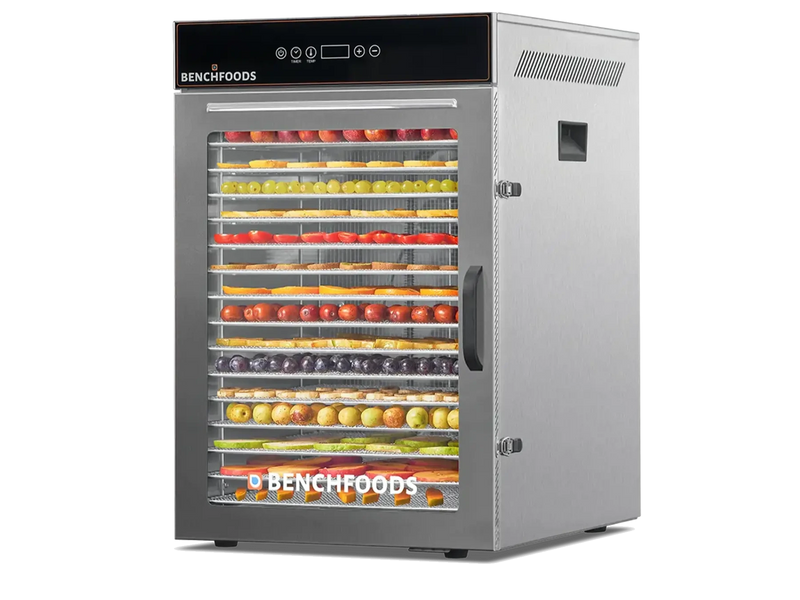
BenchFoods Tip: the 10-tray and 16-tray BenchFoods dehydrators have an adjustable temperature range of 15 to 90 °C (59 to 194 °F), a 199-hour digital timer and stainless steel mesh trays. Browse the Home Range for the kitchen, or the commercial range if you dry in bigger batches.
What are the downsides of freeze drying and dehydrating?
Freeze drying
- Cost. The machine is expensive, and long-term storage needs extra packaging [1].
- Time. A cycle takes 20 to 40 hours [1].
- Space, power and noise. It needs good ventilation, uses significant energy, and some models are quite loud [2].
- Upkeep. The vacuum pump needs regular oil changes unless you buy an oil-free pump [1].
- Food limits. High-fat foods do not freeze dry well [1][2].
- Food safety. It leaves bacteria dormant rather than killing them, so meat and eggs still have to be cooked [2].
Dehydrating
- Shorter maximum storage life. Properly packaged dried food can keep for years [5], but freeze-dried food can last longer, up to 25 years [1].
- Texture change. Food shrinks and turns chewy or crisp [1].
- Vitamin C. Heat-sensitive vitamins such as vitamin C can be lower than after freeze drying [2][4].
- Narrower range. It suits mainly fruit, vegetables, herbs and meat, and it cannot dry mixed meals or dairy the way a freeze dryer can [1].
Which is better: a freeze dryer or a dehydrator?
Neither wins on every count, so the better question is what you want the food for.
Choose a freeze dryer if your main goal is long-term food preservation: food that keeps for many years, complete meals, dairy or eggs, and you are happy to pay for the machine and wait through long cycles.
Choose a dehydrator if you want to eat what you make: jerky, biltong, dried fruit, fruit leather or herbs. It is also the one for stretching fresh food further and wasting less, for knowing exactly what is in your snacks and meals, for drying big batches without spending thousands, and for a machine that is quick, simple and low-maintenance.
If a dehydrator fits, start with the Home Range for the kitchen or the commercial range for higher volumes. The 16-tray model has 2.56 m² (27.5 sq ft) of tray area. Not sure which size you need? Talk to a specialist, or start with our Dehydrating 101 guides if drying is new to you.
More questions about freeze drying and dehydrating
Can you freeze dry food in a dehydrator?
No. Freeze drying needs the food frozen solid and a powerful vacuum to turn the ice into vapour [1], and a dehydrator has neither. You can dry food in a dehydrator and get a good dehydrated result, but it will not be freeze-dried food.
Does freeze drying kill bacteria?
No. Freeze drying leaves microorganisms dormant. If moisture comes back, for example when you rehydrate the food or store it badly, bacteria can become active again [2].
Is a dehydrator or a freeze dryer better for jerky?
Jerky is traditionally dehydrated, which gives its chewy texture. Freeze-dried meat is a different product: it is crunchy and, if it started raw, it is still raw until cooked [2]. See our jerky page for the dehydrating route.
Do you have to rehydrate freeze dried food?
Not always. Some freeze-dried foods, such as candy, are eaten as they are, but most foods are rehydrated with warm water, broth or a dairy product, depending on the food [1].
What's the difference between dried, dehydrated and freeze dried?
"Dried" is the umbrella term for any food that has had most of its water removed, whether by sun, air, an oven, a dehydrator or a freeze dryer. "Dehydrated" usually means dried with controlled heat and airflow, as in a dehydrator. "Freeze dried" is the vacuum method described above. Dried fruit in a shop could be any of these, so check the label.
Sources
- University of Arizona Cooperative Extension, "Basics of Home Freeze Drying" (az2097a, January 2025). extension.arizona.edu
- Utah State University Extension, "Ask an Expert – Freeze-Drying Food at Home: Tips for Safe, Successful Results" (15 May 2026). extension.usu.edu
- National Center for Home Food Preservation, "Packaging and Storing Dried Foods". nchfp.uga.edu
- Tylewicz et al., "Design of Healthy Snack Based on Kiwifruit", Molecules 2020, 25(14), 3309. pmc.ncbi.nlm.nih.gov
- Utah State University Extension, "Food Storage - Will I Use It?" (Live Well Utah newsletter, March 2014). extension.usu.edu
- Bhatta, Stevanovic Janezic and Ratti, "Freeze-Drying of Plant-Based Foods", Foods 2020, 9(1), 87. pmc.ncbi.nlm.nih.gov